Academic Freedom
Academic freedom is the conviction that the freedom of inquiry by faculty members is essential to the mission of the academy as well as the principles of academia, and that scholars should have freedom to teach or communicate ideas or facts (including those that are inconvenient to external political groups or to authorities) without being targeted for repression, job loss, or imprisonment. American Library Association – https://www.ala.org/advocacy/intfreedom/academicfreedom
Academic freedom is the indispensable requisite for unfettered teaching and research in institutions of higher education. As the academic community’s core policy document states, “institutions of higher education are conducted for the common good and not to further the interest of either the individual teacher or the institution as a whole. The common good depends upon the free search for truth and its free exposition” (1940 Statement of Principles on Academic Freedom and Tenure, which has been endorsed by more than 280 national scholarly and educational associations). AAUP
Sweezy v New Hampshire, 1957
https://constitutioncenter.org/the-constitution/supreme-court-case-library/sweezy-v-new-hampshire
The essentiality of freedom in the community of American universities is almost self-evident. No one should underestimate the vital role in a democracy that is played by those who guide and train our youth. To impose any strait jacket upon the intellectual leaders in our colleges and universities would imperil the future of our Nation. No field of education is so thoroughly comprehended by man that new discoveries cannot yet be made. Particularly is that true in the social sciences, where few, if any, principles are accepted as absolutes. Scholarship cannot flourish in an atmosphere of suspicion and distrust. Teachers and students must always remain free to inquire, to study and to evaluate, to gain new maturity and understanding; otherwise, our civilization will stagnate and die.
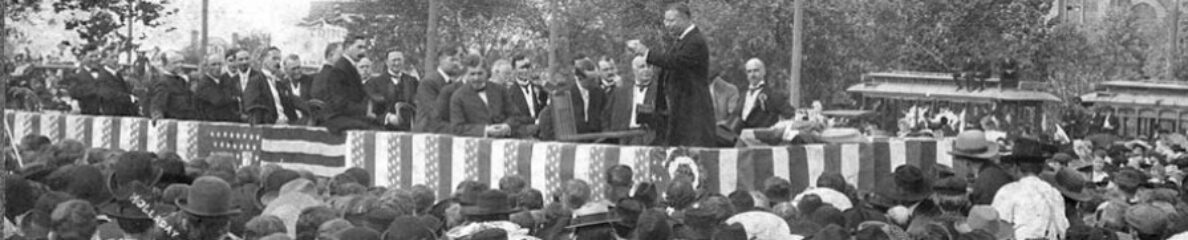
Teddy Roosevelt from the Bassett Affair – 1903 – 05
In 1905, U.S. President Theodore Roosevelt visited Durham and praised Trinity College (now Duke University) for its decision to support academic freedom in the controversy over John Spencer Bassett’s respectful remarks about Black leader George Washington Carver. Bassett was not dismissed, and Roosevelt appro, “You stand for Academic Freedom, for the right of private judgment, for a duty more incumbent upon the scholar than upon any other man, to tell the truth as he sees it, to claim for himself and to give to others the largest liberty in seeking after the truth.” https://web.archive.org/web/20060502182405/http://www.lib.duke.edu/archives/exhibits/AcademicFreedom/bassettaffair.htm
Jefferson
“Free inquiry must be indulged, and how can we wish others to indulge it while we refuse it ourselves?” Thomas Jefferson, 1787
Frederick Douglass
Frederick Douglass, as a twelve-year-old, was kept from reading by a slave owner. “From that moment, I understood the pathway from slavery to freedom… The argument which he so warmly urged, against my learning to read, only served to inspire me with a desire and determination to learn.” – Narrative of the Life of Frederick Douglass, 1845
Academic Freedom & the Politics of the University
The attack on education is itself not new – right-wing think tanks and politicians have been at it for decades. But this moment seems somehow more dangerous, as Republican lawmakers and militant activists use their power to send censors directly into classrooms and libraries, promising conservative parents they will regain control of their children against the specter of “woke” indoctrination. In one of those inversions of meaning so adroitly practiced by the right, censorship is being enacted in the name of free speech and/or academic freedom. August 01 2024 Daedalus magazine Joan Wallach Scott
https://direct.mit.edu/daed/article/153/3/149/123984/Academic-Freedom-amp-the-Politics-of-the
The most important aspect of freedom of speech is freedom to learn. All education is a continuous dialogue – questions and answers that pursue every problem on the horizon. That is the essence of academic freedom. William O. Douglas
By academic freedom I understand the right to search for truth and to publish and teach what one holds to be true. This right implies also a duty: one must not conceal any part of what on has recognized to be true. It is evident that any restriction on academic freedom acts in such a way as to hamper the dissemination of knowledge among the people and thereby impedes national judgment and action. Albert Einstein
Academic freedom is the lifeblood of meaningful scientific endeavour and a precondition for universities to assume their considerable responsibilities toward society. Worryingly, academic freedom – and its close relative, institutional autonomy – find themselves increasingly at risk in Europe and across the globe. For the European University Association, it is essential to support universities as central actors in the protection and promotion of academic freedom. This is why EUA has developed a set of key principles highlighting why academic freedom is so important for universities and wider society, as well as guidelines on how we can all contribute to making academic freedom a daily, lived reality on campus. https://www.eua.eu/our-work/topics/academic-freedom.html
“The First and Fourteenth Amendments to the Constitution afford to the citizen and to the press an absolute, unconditional privilege to criticize official conduct despite the harm which may flow from excesses and abuses…. The theory of our Constitution is that every citizen may speak his mind and every newspaper express its view on matters of public concern, and may not be barred from speaking or publishing because those in control of government think that what is said or written is unwise, unfair, false, or malicious.” — Supreme Court Justice Arthur J. Goldberg, in concurrence with the New York Times v. Sullivan decision, 1964
“That they are educating the young for citizenship is reason for scrupulous protection of Constitutional freedoms of the individual, if we are not to strangle the free mind at its source and teach youth to discount important principles of our government as mere platitudes.” — Supreme Court Justice Robert H. Jackson, West Virgina v. Barnett, 1943
“First amendment rights, applied in the light of the special characteristics of the school environment, are available to teachers and students. It can hardly be argued that either students or teachers shed their constitutional rights to freedom of speech or expression at the schoolhouse gate. This has been the unmistakable holding of this Court for almost 50 years.” — Justice Abe Fortas, Tinker v. Des Moines Independent Community School District, 1969
“Standard First Amendment doctrine condemns content control by governmental bodies where the government sponsors and financially supports certain facilities through the use of which others are allowed to communicate and to exercise their own right of expression. Government is allowed to impose restrictions only as to “time, place, or manner” in the use of such public access facilities — public forums…. If the state is conducting an activity that functions as a marketplace of ideas, the Constitution requires content neutrality. Thus, a state university may not override editorial freedom for student newspapers.” — Second Federal Circuit Court of Appeals, Muir v. Alabama Educational Television Commission, 1982
“Vital First Amendment speech principles are at stake here. The first danger to liberty lies in granting the State the power to examine publications to determine whether or not they are based on some ultimate idea and if so for the State to classify them. The second, and corollary danger is to speech from the chilling of individual thought and expression. That danger is expecially real in the university setting, where the State acts against a background and tradition of thought and experiment that is at the center of our intellectual and philosophic tradition.” — Justice Anthony Kennedy, Rosenberger v. Rector and Visitors of the University of Virginia, 1995.