R U Speechless?

This web site began with a class of communications students in the spring of 2013 who challenged some of the constitutional infirmities in Radford (Va.) University speech policies.

Some of the policies changed as a result, and some should have changed but did not. The moral of the story? The struggle for freedom is endless, and it  requires patience, compassion and courage.

— Prof. Bill Kovarik, 2026

——-

Freedom of speech and press are fundamental rights guaranteed under Sec. 12 of the Virginia Constitution, the First Amendment of the US Bill of Rights,   Article 19 of the Universal Declaration of Human Rights,  and Article 11 of the Charter of Fundamental Rights of the European Union.

Academic freedom is specifically established in Article 13 of the EU Charter, and linked in the US to the First Amendment by Chief Justice Earl Warren in Sweezy v New Hampshire, 354 U.S. 234  (1957). The court’s opinion noted:

The essentiality of freedom in the community of American universities is almost self-evident. No one should underestimate the vital role in a democracy that is played by those who guide and train our youth. To impose any strait jacket upon the intellectual leaders in our colleges and universities would imperil the future of our Nation.  

And yet,  freedom of speech is often not recognized in the one place where it ought to be respected the most:  A college campus in the USA.

Today many universities simply refuse to recognize First Amendment rights until they are forced to do so by a court. At Radford University, this web site  formed the report of a special topics class requested by then-provost Sam Minner in 2013. It continues to the present to track limits on student and faculty expression. Continue reading “R U Speechless?”

Censorship by Theft at Radford University

Editorial, Washington Post, Nov 14, 2019 —  Radford University, a taxpayer-supported institution in southwestern Virginia, is in a public relations hole entirely of its own making. The question is how deep its administrators will insist on digging…

It turns out, after what campus police called an “in-depth” investigation, that a low-level university employee — neither administrator nor professor — was caught on video and admitted stealing papers from four of the news racks, as The Post’s Joe Heim reported. The administration and police won’t reveal the thief’s identity, although they know it; they won’t charge the employee because they say taking free newspapers is not a crime; and they won’t offer an explanation of who swiped the papers from 18 other news racks. Nor will they offer a motive or explanation for the theft…

The university’s strategy, if you can call it that, is tailor-made to prolong Radford’s embarrassment, calling into question its leadership’s judgment…

MORE — 

RU Free Speech protest May 1

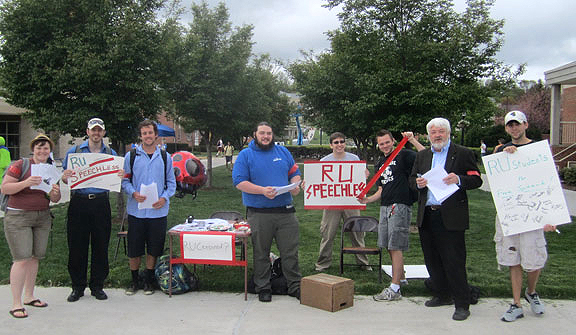
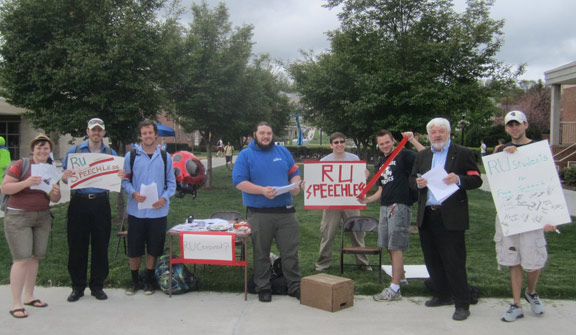
To protest Radford University policies restricting freedom of speech on campus, students and faculty rallied outside the Hurlburt student on May 1, 2013.

With the Faculty Senate, the Council of Deans and the Student Government Association all demanding reform of RU’s archaic prior restraint policies, and legal analysis showing clear faults in the policies, the RU administration has consistently shown bad faith in refusing to discuss issues.

The highlight of the protest was the signing of a large poster by dozens of students (right in the first photo) and an attempt by Prof. Kovarik to hand a flyer to an administrator who is in charge of enforcing speech policies at RU. Not only did the administrator refuse to accept the flyer, but he fled rapidly into the building while shouting something about errors in the flyer that he refused to discuss.

Protest2a.may1
The crew of the May 1 protest (photo by Prof. Martin, who was also present).


AAUP flyer on the May 1 protest

This is the American Association of University Professors flyer which The First Amendment / Higher Education class did not create.  However, who would argue that the AAUP does not have every right to create and distribute this flyer on campus?   Is it overstated?  Obviously.  But  sometimes that’s the point of the “vehement, caustic, and sometimes unpleasantly sharp attacks on government and public officials” protected in the New York Times v Sullivan decision.    — Prof. Kovarik.

prisonerRU: PRISON CAMP ON THE NEW

(1) “Free speech zones” that limit speech to tiny designated areas.

(2) Censorship of all postings on bulletin boards for faculty and students, requiring pre-stamping.

(3)  Censorship of everything posted in the dorms.

(4) Offering only about 12 “public” bulletin boards (limited to pre-stamped postings) on the entire campus located in out of the way places where students rarely go like the basement of Heth Hall.

(5)  Tight control of all email lists (but open to commercial interests).

(6) Prohibition of anyone handing out flyers or other materials anywhere on campus except from pre-approved tables in and around the Bonnie.

(7)  Collaboration with the city to limit the signs students can place on student housing.

[Co-sponsored by RU Chapter of the AAUP]

PROTEST FOR YOUR RIGHT TO FREE SPEECH IN A FREE SOCIETY

Mayday:  Wed. May 1st

Bonnie Plaza 10 AM to 1


The rise of the administrative university

By Glen Martin, for the RU AAUP, Oct. 2012

Books are beginning to appear about the nation-wide conversion of universities away from institutions dedicated to truth and knowledge and into a business model of education.  One such book is by Benjamin Ginsberg called The Fall of the Faculty: The Rise of the All-Administrative University and Why it Matters (2011). Ginsberg chronicles the demise of academic freedom, tenure, and the traditional faculty-driven conception of a quality curriculum and the independent pursuit of truth.

Continue reading “The rise of the administrative university”

Plaid avenger strikes again!

Plaid.photoMonday, Feb. 18, 2013.

  • 07:30 — Sharp eyed university censors notice half a dozen unauthorized communications chalked into sidewalks. “#PlaidSwag” looks suspicious.  Superiors notified.
  • 09:30 — University censorship action group (UCAG) concludes that a non-cyber information attack is underway.
  • 9:45 — Vehicles parked over information attack sites to deter spread of dangerous ideas.
  • 10:00 — Criminal incident information recorded.
  • 10:15 — University powerwashing crews swiftly deployed.
  • 10:45 — Non-cyber information attack threat diluted.
  • 4:45 — Report on effective use of human resources forwarded to Superiors.
  • Unfortunately, this is all true, except the part about the UCAG — we actually don’t know what they call themselves or what they call unauthorized chalkings.